62% of diving injuries happen in the summer. Summer months lead the statistics for diving injuries by a wide margin. That’s why June, July, and August are considered Diving Safety Awareness months.
Is it true that the only safe dive is the dive you never take? How serious is the connection between diving and spinal cord injuries? We will explain the answers in this blog post.
Infographic: Diving and Spinal Cord Injuries
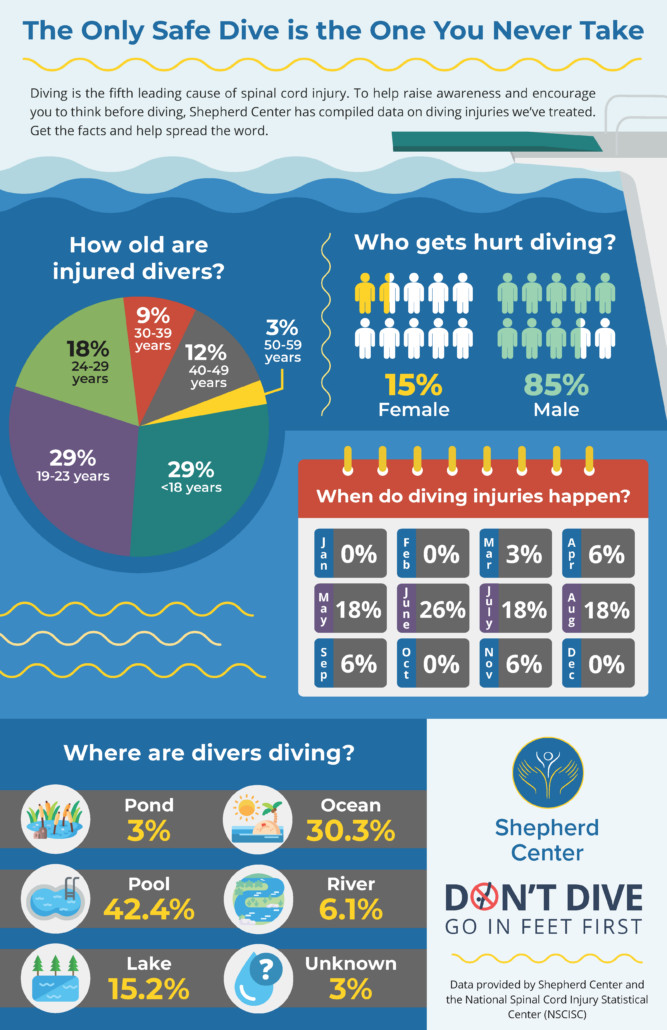
Fact 1: Diving is the fifth leading cause of paralyzing spinal cord injuries.
According to Shepherd Center, diving makes the list of the top five causes of spinal cord injuries with paralysis.
85% of individuals who get hurt diving are male and 15% are female. Most individuals who are injured are between 18 and 29 years old.
Fact 2: There are multiple ways to sustain a spinal cord injury while diving.
There are multiple ways for a dive to end in a spinal cord injury or paralysis based on the location and structure of the spinal cord. The severity of disability depends on the level of the spinal cord where the damage occurs.
The vertebrae of the spine, separated by intervertebral fibrous discs, protects the nervous system’s spinal cord. It is possible to damage the spinal cord by injuring the vertebrae and discs or by injuring the spinal cord itself. “Severe damage to the cord and nerves emerging from the vertebral column will cause paralysis,” reported WHO.
A user forum on Apparelyzed highlighted some of the many ways that diving can lead to a life-altering injury:
“My husband dove into a pool on Labor Day weekend. He is a C4.”
“My spouse dove into a sponge pit. He is now a C5/6.”
“[To me] dives must include anything headfirst, whether it be into lakes, swimming pools, the sea, trampolines or bouncy castles.”
“I made a conscious though foolish decision to launch myself from my patio roof into an above ground pool ten feet away. It was a calculated risk that turned ugly. C5/6 anterior incomplete, with all the bells and whistles.”
“I dove into a surfboard. C7 complete.”
“Dumped on the seabed by a huge wave…C4/5 complete.”
“When you swim competitively, you dive into the pool at the shallow end from a racing block. I was goofing around and dove too deep and hit the bottom.”
“I dove off a 70-foot-high cliff and was fine. Then I dove into a shallow area (of water) from about 6 to 7 feet and hit the sand on the bottom, fracturing my spine at C5/6.”
Fact 3: Water can be deceptive, even if you are a good judge of depth.
Many individuals who sustained a spinal cord injury from diving echo the same reflection: “I thought I had good perception skills. I thought I could trust myself to stay safe.”
The truth is that water often appears to be deeper than it is, which can lead to devastating errors of judgment even for experienced swimmers and divers.
Fact 4: A single dive can alter your life forever – physically, mentally, emotionally, and financially.
Misjudging water depth or diving into unfamiliar waters can lead to severe spinal cord injuries, potentially resulting in paralysis or other permanent disabilities.
Along with the physical, mental, and emotional challenges caused by paralysis, a spinal cord injury can leave you with overwhelming out-of-pocket expenses.
That’s why our nonprofit Help Hope Live exists: to prevent a medical crisis like a diving-related spinal cord injury from becoming a financial crisis. We provide one-on-one fundraising help for a lifetime and important benefits, including medical verification, tax-deductible donations, and maximum protection for vital benefits like Medicaid.
Fact 5: You can make a difference.
You have a responsibility to keep yourself and your loved ones safe from preventable diving-related spinal cord injuries. Here are a few things you can do right now:
- Educate yourself about safe behaviors and share what you learn with your loved ones.
- Always swim with a lifeguard.
- Enter water feet first, even if you do not plan to dive.
- Don’t dive at all to maximize your chances of preventing injury and paralysis.
“Have the conversations. Never dive headfirst into water you can’t see through, no matter how experienced you are. And don’t ever act on a dare or try risky stunts,” urged Janice Shevchek. “The consequences just aren’t worth it.”
Share our client Ambassador Lauren’s slogan with kids:
“If you can’t see through it, don’t dive into it.”
Real Stories: Life After Paralysis
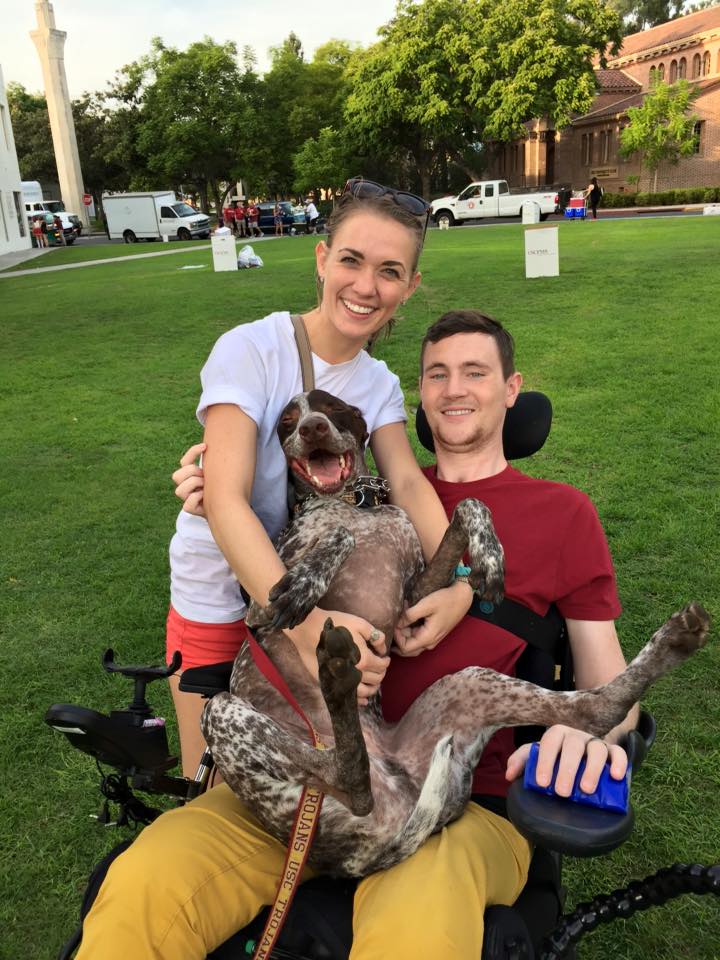
In 2014, Dillon Connolly was swimming with friends when he performed a simple dive from one area of the water to another. Storms had created a sandbar beneath the water, and the impact shattered Dillon’s C5-C7 vertebrae.
What followed was “the longest year of Dillon’s life,” explained girlfriend Kerry Sheridan. “Immediate surgery, nearly a month of intensive care, three months of intensive physical therapy, occupational therapy, speech therapy, and lifestyle adaptations.”
Dillon explained that being an experienced swimmer isn’t enough to protect you from a dive that can severely alter the rest of your life.
“I swam my entire life competitively,” he explained. “It even paid for college. I broke my neck diving into a wave where the sandy bottom went from deep to too shallow. I tell everyone I meet who asks what happened to never dive unless you can see the bottom, and to tell their kids and friends, too.”
Cole Sydnor was 16 when a diving accident left him paralyzed from the chest down.
“The average person may not understand the extent to which our injuries affect us ‘behind the scenes. Most people…are never exposed to what it takes for [us] to shower, dress, use the restroom, etc,” Cole explained in an interview. “Those are the hardest parts about living with a spinal cord injury.”
“Any medical expenses deemed unnecessary by insurance fall on my family and it becomes their responsibility to make those purchases,” Cole explained. “My elevator, room and bathroom renovation, and truck were all expenses that our community rallied to help fund.”
Today, Cole remains a Help Hope Live medical fundraising client – and he and his wife, Charisma, are content creators with over 1 million subscribers who post on YouTube about life with paralysis as an interabled and interracial couple.

Jeff Granger Harris broke his neck diving into the ocean in 2007.
“He ran in to jump over a wave like me and him had done 20,000 times,” explained Jeff’s brother, Greg. Jeff hit his head “at the right angle, at the right speed, at the right tilt of the universe” and became paralyzed. “Anything you’re used to doing, you can’t do anymore in Jeff’s situation.”
Jeff will face lifelong physical and financial challenges because of a split-second dive. Fundraising has helped him to bridge the gap between what insurance will cover and what he needs for a fulfilling and engaging life.
“This is the only life that I have and I’m going to make the best of it,” Jeff explained. “Help Hope Live allows you some of that ability through fundraising.”
Lauren Shevchek had been swimming competitively for over a decade. At age 19, she dove into a pool and fractured three cervical vertebrae. She lost feeling from her chest downward.
Lauren worked through months of inpatient rehabilitation to regain some of her independence. She and her family speak publicly about the dangers of diving in order to reduce the number of diving-related injuries.
Mom Janice explained why she is a vocal advocate for diving safety. “Teens in particular are shocked when I mention that paralysis is not just about walking. It’s about losing your ability to urinate and move your bowels on your own. Once they begin to understand, they will never forget how devastating the injury is.”
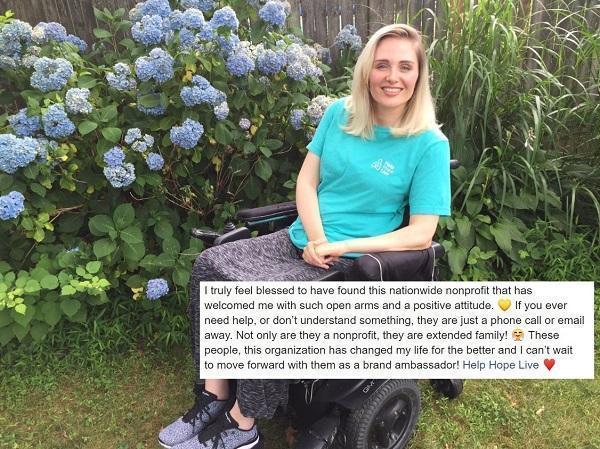
Lauren is now a client Ambassador for Help Hope Live, sharing her story and her experience with spinal cord injury fundraising to help other families.
Help Families Impacted by Spinal Cord Injuries
Financial health is often a key part of a healthy, happy future after paralysis. You can help by sharing our information with someone impacted by a spinal cord injury, or by making a donation to our nonprofit.